When learning about fire extinguishers, it is important to understand their role in protecting people, property, and businesses from the devastating effects of fire. If you are a business owner in Australia, chances are you have at least one fire extinguisher installed within your premises. The question is, are your fire extinguishers compliant, properly maintained, and ready to perform when needed most?
Fire extinguishers are active fire protection devices and must comply with Australian Standards to ensure they remain in safe working condition. Fire extinguisher installation should be carried out in accordance with Australian Standard AS 2444, while ongoing inspections and maintenance are required to help ensure compliance and reliability.
Whether you operate a commercial building, retail store, industrial facility, healthcare centre, educational institution, or office, understanding about fire extinguishers can help you make informed decisions about fire safety and compliance. As a business owner, here are five important things you need to know about fire extinguishers:
There are Different Types of Fire Extinguishers
This firefighting equipment has different types of extinguishing agents for specific fire classification. Grease fires have different properties from electrical fires, therefore, each requires a different type of extinguisher.
It is vital that you purchase a type of extinguisher that matches the type of fire that will most likely occur in your business. The following are the most common types of fire extinguishers:
- ABE or Dry Chemical Fire Extinguishers: are used for putting out Class A (ordinary combustible materials — wood, paper, etc.), Class B/C (flammable liquid or gas), and Class E(electrical equipment) fires in normal settings.
- Water Fire Extinguishers: are suitable for fire caused by wood, paper, textiles or other ordinary combustible materials. Because water is a conductor, this type of extinguisher should not be used for Class E fires. This extinguisher is also used in environments with sensitive equipment that can be damaged by the chemicals in ABE fire extinguishers.
- Wet Chemical Fire Extinguishers: are commonly used in commercial kitchens. These extinguishers put out fires caused by oil and grease. Please take note that water should never be used to put out fires caused by fats, cooking oil or grease.
- Carbon Dioxide Fire Extinguishers: put out fires caused by flammable liquid and gases (Class B and C). These are commonly installed in laboratories and similar settings.
- Sodium Chloride Fire Extinguishers: are used in fires caused by flammable metal (Class D). These are commonly used in industrial environments.
What You Need to Know About Fire Extinguishers and Australian Inspection Standards
Fire extinguisher maintenance is important in keeping the equipment in serviceable condition. Australian Standards AS 1851 states that:
- All fire extinguishers must tested every six months
- Fire extinguisher testing intervals must be recorded on a label or metal tag attached to the unit
- Visual inspection of the equipment should show that it is in working condition
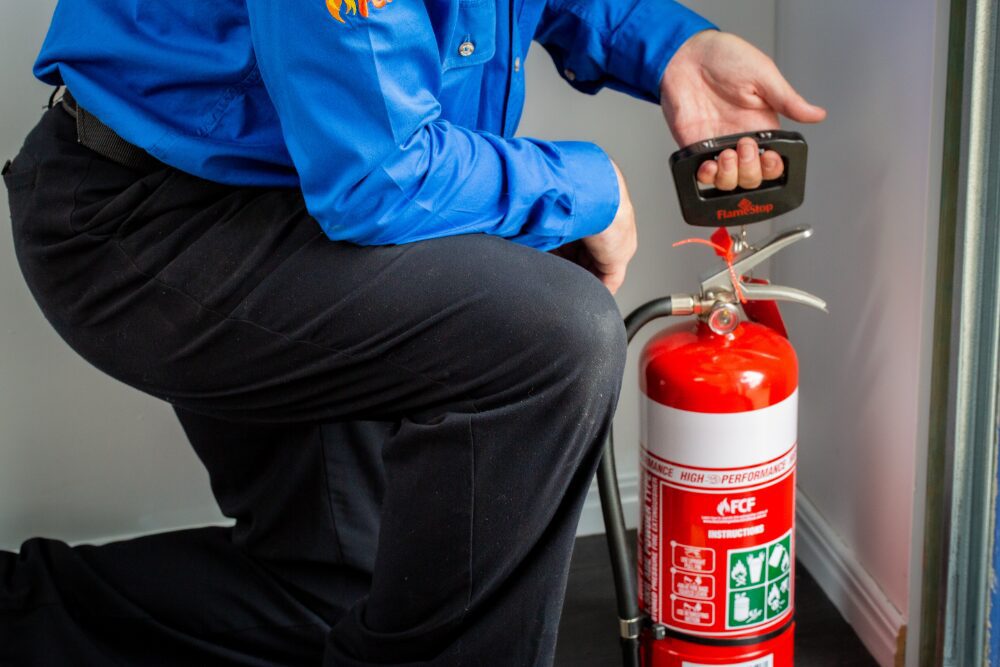
The routine inspection confirms the presence and location of each fire extinguisher. It also ensures that the canister has no visible signs of damage or tampering. The pressure gauge is also checked to ensure that it is at full capacity. Operating instructions are checked if it is still legible.
Fire Extinguishers Must be Replaced or Recharged After Every Use
When a fire extinguisher has been used or no longer in full capacity, it needs to be recharged or replaced. A fully charged fire extinguisher must be maintained at all times. If the extinguisher has been used or accidentally discharged, even a small amount, it needs to be recharged or replaced immediately so it can be used when a fire emergency occurs.
Fire Extinguishers Don’t Last Forever
Although the canisters do not have expiration dates, it is crucial to keep up with the necessary testing and fire extinguisher replacement requirements. Extinguishers must be replaced or recharged every five years from its manufacture date or last pressure test date.
Fire Extinguishers Must be Disposed Properly
Fire extinguishers can’t be thrown in the trash together with ordinary materials. Fire extinguishers contain chemicals that may be dangerous to the people and environment if not properly disposed of.
For mostly or entirely full extinguishers, you may call your local fire department and inquire about dropping old cylinders at the station. You may also take your extinguisher to a hazardous waste facility.
For nearly empty fire extinguishers, release the remaining pressure by squeezing the lever. Take off the extinguisher head to ensure that the cylinder is empty. Call your local steel recycling facility and ask to drop off the empty canister.
Schedule Fire Extinguisher Services in Gold Coast
FCF Fire & Electrical is happy to provide the fire extinguisher services you need to keep your establishment safe, protected, and compliant with Australian Standards. Whether you’re looking to learn more about fire extinguishers, need assistance selecting the right extinguisher for your property, require routine inspections, or need to procure new equipment, our experienced team is here to help. We offer a comprehensive range of fire protection services, including the supply, installation, testing, and maintenance of fire extinguishers. Contact FCF Fire & Electrical Gold Coast today to discuss your requirements and receive a free quote.